Sunday, March 18, 2018

William Clay and Elizabeth Mallon Clay Celebrate Golden Wedding Anniversary

Relatives of William Clay and Elizabeth Mallon Clay gathered in Quincy, Adams County, Illinois to help the couple celebrate their Golden Wedding Anniversary.

Clay Golden Wedding

William and Elizabeth were married 9 April 1864 at Cumberland, Allegany County, MD at St. Patrick's catholic church by Fr. Brennan. Fifty years later another Fr. Brennan officiated at the mass celebrating their Golden Anniversary at St. Rose of Lima parish in Quincy. 

The couple celebrated on Sunday and Monday, April 12-13th, 1914 surrounded by friends and relatives. Among the relatives that attended were six of the couple's eleven children. John Clay of Chicago, Mrs. Steven Struck (Susan) of Quincy, Mrs. John G Kroner (Mary) of Kansas City, Kansas, Frank Clay of Kansas City, Missouri, and Misses Margaret and Anna Clay of Quincy. Their son Joseph of Chicago was unable to attend. The other four children, John, William, Martin and Annory passed away before they reached adulthood. 

The couple had seven grandchildren who all attended - Helen Elizabeth Struck; W. Lloyd Kroner; John W. Clay (son of John G Clay); Lilian, Margaret, Joseph and Mary Clay (children of Joseph Clay).    

Other relatives that attended were Henry Clay, William's brother from Baring, Missouri; Mr. and Mrs. William Smith and Mollie Smith of St. Louis; Mrs. Kate Foster; and Mary Binsbacher of St. Louis. 

The celebrations were covered in the Quincy newspapers of the day. There was a dinner at 4 o'clock on Sunday followed by mass on Monday morning.  William was 75 and Elizabeth was 73. The couple traveled west from Cumberland, Maryland over forty-five years before and settled in Quincy, which was the end of the railroad at the time. 


Sources
1. Quincy Daily Journal, "Marital Happiness Is Lasting." 11 April 1914 page 8; "Mass Celebrated in Honor of Their Golden Wedding", 13 April, 1914; . Digitized on Newspaper Archive of the Quincy Public Library <http://quincylibrary.org/newspaper-archive/>

2.  The Quincy Whig, "To Celebrate Golden Wedding Anniversary," 12 April 1914, page 2. Digitized on Newspaper Archive of the Quincy Public Library <http://quincylibrary.org/newspaper-archive/>

3. Invitation to Fiftieth Anniversary Celebration, copy of original given to the author by James Coakley, great-grandson of William and Elizabeth Mallon Clay.

4. Quincy Daily Herald, "Golden Wedding Mr. and Mrs. Clay." 11 April 1914, page 10.  

5. Clerk of Circuit Court, Allegany County, Maryland; Marriage Register Vol 2, page 22 line 8, Marriage of Willliam Clay and Elizabeth Mallon. Visit to courthouse, September 1991. 

Saturday, March 10, 2018

Ruthanna

This blog was created to capture stories about the Sennott and Coakley families. This time I'd like to share the story of one of the family pets, a Cavalier King Charles Spaniel named Ruthanna.

Ruthanna crossed over the Rainbow Bridge on Wednesday, March 7, 2018. She would have been 16 on April 15th.

In 2008, two good friends, Lesa and Tim worked with Lucky Star Rescue. They were fostering a rescue named Karmen. I had been thinking about getting a dog since I no longer had to travel for work and they introduced us. Karmen was precious and she came to live with me. I started fostering for Lucky Star. A few Cavalier's stayed with Karmen and I and then moved on to their furever homes.

In March, 2009 I got a call asking if I could foster a rescue. Lucky Star had raised money and were going to an auction where hundreds of dogs were being sold. That weekend when I went to pick up my foster, I met Ruthanna.


She had spent the first  almost 7 years of her life as breeding stock in a puppy mill and had been treated very badly.  I don't think she had been out of a cage for any period of time and had health problems including a knee that required surgery. When we got home, Ruthanna stood in a submissive position and didn't move. I would pick her up periodically and carry her outside. Then we'd come back in the house and she would be still again.

After a few days, she started to come out of her shell. Ruthanna was a joy to have around. It didn't take long before I knew she would be a failed foster and was going to stay as part of our family.  I was told that I'd be lucky if she lived a couple of years, she was in such bad shape.

It is amazing what a little love can do, she soaked it up like a sponge. Soon she was exploring the house. She would sit in the chair with me in the evenings while we watched TV or read.


It took her months before she barked the first time. She only barked when she wanted to go out or was hungry. She had an internal clock that was amazing. It went off at 6:30 am and 5:00 pm. She could be very persistent when she was hungry. She relished her food, I think she must have gone hungry many times while she was in the puppy mill.

Neither of the girls knew what to do with toys, but Ruthanna found a little stuffed animal that she used to carry around. She didn't play with it, but carried it around like she would a puppy. It was her constant companion until Bentley came to live with us in 2011. Then her maternal instinct switched to him and I don't think she ever picked up the stuffed toy again. She loved him and mothered him until the day she died. Part of her daily morning ritual was washing his face. 


Bentley taught Ruthanna how to play. He would throw his toys up in the air and carry them around. He was a bundle of energy and she would sit and watch him play. One day after she had been watching him, she went over to a toy he had tired of and started pushing it with her nose and barked at it. It was such fun to watch her blossom into the dog she became.

When we would go for walks, Karmen would take off after a squirrel or a lizard, Ruthanna just sat and watched her. The look on Ruthanna's face said, "Karmen you are never going to catch that squirrel, why do you expend so much energy trying?"

I went home for lunch every day and the three of us would go for a walk. About half way to the corner, Ruthanna would sit down and wait for Karmen and I to walk to the corner and back. Then she would re-join us and we would head home. Later when Rick moved into the neighborhood, she would stop at his house when we walked. After a walk, the girls each got a carrot. Ruthanna would stand with her bottom in the air and munch on her carrot.


Thanks to Dr. Krug at Campbell Village Vet, Ruthanna had her knee surgery. Her health problems persisted through the years but Dr. Krug found a way to overcome them.

Ruthanna found a special place in my Dad's heart. She would get up in the chair with him and sit for hours. She could look so pitiful at times. When I was a little girl I had a doll named Pitiful Pearl, that soon became Ruthanna's nickname.


Ruthanna brought so much love into our house. Both of our world's changed the day she came to live with us. I'm not sure who was rescued, Ruthanna or me. She was so full of unconditional love. Every day when I came home, she was at the door to greet me. When I worked at home she was at my feet under my desk. I love all three of the dogs, each has a different personality and brings so much to our lives. Ruthanna will always have a special place in my heart, she was so gentle and sweet.


Sunday, February 18, 2018

1912 Oakland

An article in the Waterloo Republican on Wednesday, July 3 1912 read

"George W. Ziebold has received his new car, one of the finest Oaklands, which he purchased from Jobb & Ruch. It is equipped with the latest improvements, electric light, etc."

Edward M. Murphy incorporated the Oakland Motor Car Company in 1904, an offshoot of his Pontiac Buggy Company. In 1908, the Oakland Motor Car Company and the Pontiac Spring and Wagon Works merged together under the Oakland Motor Car Company. "Later in 1908, the first Oaklands went to market. The first Oaklands used an unusual Alanson Brush designed two cylinder vertical engine, which rotated clockwise. The type of engine was common in French cars but not popular with American engineers. The engines worked fine, but the cars did not sell well."

In 1909, Murphy sold 50% interest in the Oakland Motor Car Company to William Durant of General Motors. Oakland also introduced new engines, new body styles and new models that year. In the Summer of 1909 Murphy died and the remaining 50% of the company was sold to General Motors.

In 1932 the Oakland name was dropped and it became the Pontiac Motor Car Company.

Oakland made a number of different models in 1912, there isn't enough information in the newspaper article to know which one George purchased. Here are some examples of adds and pictures of the 1912 cars.

Model "40" Sociable Roadster

Oakland 30 Runabout


1912 Oakland Model 40 Touring - "The Oakland was a quality-built car that offered excellent and reliable transportation, but it came at a price. The Model 40 for 1912 sold for $1,450 in 1912 when one of Henry Ford's Model Ts sold for $690."

Oakland Model 40 1912


1912 Oakland 45
President Taft in 1912 Oakland 45


Sources
1. Waterloo Republican, July 3, 1912.
2. Dragone website https://www.dragoneauctions.com/1912-oakland-model-40-touring
3. American Automobiles http://www.american-automobiles.com/Oakland-1909-1919.html
4. Brass Auto http://www.brassauto.com/brass-pages/oakland-photos.html
5. Detroit Public Library Digital Collection https://digitalcollections.detroitpubliclibrary.org/islandora/search/catch_all_fields_mt%3A%28oakland%2045%29%20OR%20catch_all_fields_et%3A%28oakland%2045%29
6. Heritage Center - Generations of GM History https://history.gmheritagecenter.com/wiki/index.php/Oakland_Motor_Car_Company

Saturday, February 17, 2018

Academy of the Visitation Graduation 1909


Graduation Invitation - 1909
Visitation Academy, St. Louis, Missouri

Visitation Academy was founded in 1833 in Kaskaskia, Illinois by the Order of the Visitation of Holy Mary. The school moved to St. Louis in 1844. In 1909 it was located at Cabanne and Belt Avenues and there were 183 students enrolled.   

The Class of 1909
Top Row: Marion Bishop, Fort Sheridan, Ill.; Marie Sullivan, Geraldine Collum, Maizie Whyte, Georgia Sullivan of St. Louis. 
Second Row: Clara Ziebold, WAterloo, Ill.; Josephine Dickson, St. Louis; Gail Maguire, St. Louis; Susie Cabanne Goode, Honolulu; Maryzita Cahill, Kansas City.
Bottom Row: Norma Weis, St. Louis; Katherine Degnan, Wilburton, Ok.

Articles from the beginning of the school year refer to thirteen students. Celeste Withers is not listed as a graduate in the articles about the commencement exercises.  

Among the graduates in 1909 was Clara Ziebold, class valedictorian. Clara's scrapbook of her final year at Viz is in the collection of Rick Sennott and provided much of the material for this article. 

Clara Ziebold, 1909

The school year ran from September 8, 1908 to June 11, 1909. Class colors were lavender and white and the class flower was Lavender Sweet Peas. The Class yell was "Lavender and White, Lavender and White Class '09 Out of Sight". The class motto was "Amor Vincit Omnia" which means Love Conquers Everything.

Classes attended by the Seniors included French, Philosophy, Latin, Mathematics, Composition and Music, all taught by the sisters. Occasional musicals, recitals, and dances offered a break from daily studies for the young ladies.

Social events memorialized in Clara's scrapbook include dances for Veil Prophet, Halloween, Valentine's Day, an ice cream social, a St. Louis University football game, flower show, concerts and recitals. The girls were inducted into the Alumnae Association of Visitation Academy in April, 1909 at the Annual Re-union.

Botany Class

At the Church 

 The Story Was Rather Sad

The Tennis Fields

A private Graduation ceremony was held on Friday, June 11, 1909, only parents, teachers, students and the graduates were present. "Miss Georgia Sullivan read the class essay. Miss Marian Bishop, who won the certificate in music, played a piano solo, and a very enjoyable musical program was given by the students." Archbishop Glennon made an address and presented the diplomas and medals.

The text of Clara's valedictorian address was preserved in her on hand in the scrapbook:

Dear Sisters and Companions,

The coveted and earned distinction to speak for my class has been bestowed upon me.
In a certain sense I am proud of it, it is sweet. But I feel the throne pierce through the gathered flower. My words must say farewell, must tell the ending of the beautiful period in which our budding lives have been under a training hand.

In the retreat blind of dangers, weak little girls we have grown in the sunshine of culture, we have tried our minds at modest sciences, Have had imparted to them the dogmas of the highest  that of religious have been taught to see and love in every beauty and event something divine have been urged to duty by sweetest advice and soothing consolation and led from sorrow by the hand of love.

Looking back upon it we catch glimpses of blue skies, sunshiny ripples, green hedged fields, pleasant smiles we hear girls laughter and the sisters words of sweet correction

We must leave it! How blessings brighten as they take their flight. But is our happiness doomed to fade in the sphere of womanhood? Are not the influences of the world all our friends? There are dangers in society we are told beware Into this great unknown may that his open before no we must go alone. With what wisdom shall we choose and with what success shall we engage in the activities that there invite our trial? With what strength  shall we resist the fancies that may steer us into unsafe whirlpools of pleasure? We are encouraged; we are warned by loving words and inspired by fondest hearts. They say "let not your will like faulty air ships be whirled astray, but let it keep firm in the God -given course so love that others grief may be your own. Let adversity work in you its glories. Let you sorrows be wreathed with virtues. Character thus trained will mold others and be perfected according to the words given by your alma mater

Failure will be our own achievement. We will try to held this lesson and by being her true daughters praise our Alma Mater. 

Most beloved and revered teachers, gratitude for the sacred treasures you have given us we express for each in the lines of the poet

Though time her bloom is steeling theres still beyond his act the wild flower wreath of feeling the sun beam of the heart

Let us our dear companions, friends remain and you dear sisters, mothers be to us who bid you all a sad, a sad farewell.

After the ceremonies, Mr and Mrs. J. F. Sullivan, parents of Georgia Sullivan, entertained the class at a dance held at the Normandy Club. 

Sources
1. The Girl Graduate, Her Own Book, scrapbook of Clara Ziebold's senior year at Visitation Academy in St Louis, Missouri. Original in collection of Richard Sennott. 
2. "School Days at Visitation Academy", unidentified newspaper clipping from scrapbook of Clara Ziebold.
3. "Notes from Visitation Acadmey, Cabanne", unidentified newspaper clipping from scrapbook of Clara Ziebold.
4. Unidentified newspaper clipping in scrapbook of Clara Ziebold described the commencement exercises. 


Sunday, February 4, 2018

Waterloo High School Class of 1906

Graduating Class of 1906
Standing: Carlisle Morrison, Alfred Hess, Harry Sennott
Seated: Hulda Jobusch, Julia Crocker


The commencement exercises were held in the Memorial Opera House in Waterloo, Monroe County, Illinois on Wednesday evening, May 30th, 1906. "The stage had been tastefully decorated with pottages and ferns, and the hall was cozy and cheering." The program included an oration by each of the five graduates. 


The ceremonies opened with musical selections by the Orpheus Orchestra followed by the salutatory by Miss Julia Crocker titled "Public School Education." "Her delivery was splendid, clear and distinct, and her topic showed much care and skill in its preparation. Her reasons for a good education were along sound lines and showed a splendid mastery of her subject."

Miss Emma Quernheim played a musical selection before the next speech, "Kind of Patriotism Necessary Today" by Alfred Hess. "His subject proved a splendid one and was replete with references to many acts in the past events of our country's history. His work showed careful study and proficiency of detail which all admired."

William Bode, Alois Koenigsmark, Herman Oldendorph, and Louis Bode, the Mason Quartette, provided the next musical selection. Carlisle Morrison presented, "The Boss of the Animal Kingdom."  "The beginning of the subject was treated in a scientific manner with enough humor to make a radical departure from the usual commencement exercise, which made a decided hit with the audience. The delivery was splendid throughout."

"The Elements of Success" by Harry Sennott, "was another splendid oration, combining eloquence with deep study and careful preparation. The thread of the discourse was followed closely and in a logical manner which was greatly admired by the audience."

The Orpheus Orchestra returned to the stage and played selections from "The Mikado".

The final speech by the graduates of the day was by the Valedictorian, Hulda Jobusch. "In her topic Memories she paid a touching tribute to Memorial services, and to the many pleasing episodes of the class days, reminiscences of class mates and teachers."

Reverend J.B. House addressed the gathering on "the general subject of education". "The diplomas were then awarded after which the graduates were remembered by many admiring friends, receiving flowers and tokens in profuse abundance."

Diploma of Harry B Sennott

 The commencement exercises were supposed to be followed by the school picnic the next day, however, it was delayed until Friday by heavy rain. The students from all grades from the public school, the Catholic school and the Evangelical school gathered at 9:00 am Friday morning along with their families and friends. They "formed a line of 600, making a beautiful parade, the girls all with parasols and the boys with canes, and all with flags."

The procession marched through the streets to the park where the picnic took place. There was "a generous supply of lemonade" and "various games were indulged in during the day in which the little folks took great delight."  Business was suspended for the day at the request of the Mayor.


Sources
1. "Commencement Exercises", The Waterloo Republican, Wednesday, June 6, 1906, page 1 column 3.
2. "School Close", The Waterloo Republican, Wednesday, May 30, 1906, page 1 column 3.
3. Graduation Program, Waterloo High School, 1906 in the collection of the author. 
4. Picture of Graduating Class 1906 in the collection of the author.
5. "School Picnic", The Waterloo Republican, Wednesday, June 6, 1906, page 1 column 3.
6. Diploma of Harry B Sennott in the collection of the author. 


Sunday, January 8, 2017

Harry Sennott Marries Clara Ziebold


Society Belle Announces Engagement 

The headline in the Waterloo Times announced the engagement of Miss Clara Ziebold to Mr. Harry Brey Sennott. On Saturday, January 1, 1916, a party was held at the Ziebold house in honor of guests, Miss Marguerite Hubbell of Elgin, IL, Miss Marie Loper of Chicago, and Miss Geraldine Collum of St. Louis. The house was decorated with pink carnations, azaleas and ferns. After an evening of playing 500, luncheon followed. "With the service of the first course guests discovered  little cupids bearing the announcement of the engagement of Miss Clara Ziebold second daughter of Mr. and Mrs. George Ziebold to Harry B. Sennott only son of Dr. and Mrs. J. S. Sennott of this city."


Clara was active in a number of groups in Waterloo - the sewing club, the Domestic Science Club, the 500 Club to name a few. Members of the sewing club meetings provided the opportunity for Clara's friends to shower her with gifts.

On Thursday afternoon, March 16, Clara's sister in law, Mrs George C. Ziebold hosted the Sewing Club at her home - Whistlecote Farm. "The afternoon was most pleasantly spent at needle work. The guests also enjoyed a number of vocal selections by Mrs. Carlton Ball and Mrs. N Nasseem. At six o'clock delicious luncheon was served by the hostess. The dining room was artistically decorated in honor of St. Patrick Shamrocks, pretty gilt harps, green and white carnations and other emblems of the day were used effectively in ornamenting the luncheon table. The center piece consisted of a large green harp surrounded by carnations. Before leaving the table Miss Clara Ziebold was given a cord and asked to draw it toward her and as she did so the strings of the harp were rent asunder and thru the sides of the harp appeared many beautiful pieces of linen which were showered upon Miss Ziebold, whose marriage to Mr. H. B. Sennott will take place shortly after Easter. The shower arrangement was indeed clever and quite as much of a surprise to the other guests as it was to Miss Clara."

The festivities continued at the home of Mrs. Wallace Mitchell on Saturday, April 8th. The Sewing Club met in honor of Clara.  The guests sewed tea towels for the bride. "A dainty luncheon was served at five o'clock. The decorations were carried out in yellow. Jonquils were used for the centerpiece and the favors and place cards were Easter novelties. At the close of the luncheon an Easter basket of beautiful handkerchiefs was quite cleverly showered upon Miss Ziebold."

The final shower for Clara was a surprise kitchen shower held at the home of Mrs. Roy Gauen who entertained the Sewing Club at her home on the afternoon and evening of Thursday, April 13th.  "The dining room with its table beautifully decorated with pink sweet peas and dainty pink favors made a charming picture. In the center of the table, with a mass of sweet peas grouped around her, was found a miniature bride. Before her, leading from the center of the table, an array of fourteen dainty doll bridesmaids dressed in pink, made their way to Miss Ziebold's place at the head of the table. Covers were laid for fourteen. The hostess served an elegant six-course dinner, which in itself, showed an unusual amount of skill and proficiency in its preparation. Upon leaving the table the bride-to-be was surprised with a large basket containing many useful aluminum gifts."

The Wedding Ceremony


On the evening of Tuesday, April 25, 1916 at 5:00 pm Harry B Sennott married Clara M Ziebold in the parsonage of SS. Peter and Paul catholic church. Harry wasn't catholic so they couldn't marry in the church. The couple, their parents, and the attendants - Miss Evelyn Ziebold and Dr. I.A. Leunig arrived at the residence where they were married.


The bride "was tastefully gowned in an exquisite creation of white tulle hanging from the shoulders. The bridal veil was held in place by a wreath of orange blossoms and she carried a beautiful shower bouquet of brides roses and valley lilies."


Clara's sister Evelyn was her bridesmaid. "She wore white taffeta and silk lace and carried yellow roses."

A wedding feast and reception were held at the Ziebold residence on Moore Street immediately after the ceremony. "The party entered the home to the ever appropriate melody of Lohengrin, played by Miss Pearl Pinkel congratulations were showered upon the happy pair. The Easter colors of yellow and white were the basis of the decorations that adorned the home throughout and festoons of  smilax, Easter Lillies and jonquils made a very beautiful effect. Huge sprays and bouquets of sweet flowers, artistically placed, lent a charming fragrance that mingled with the happy atmosphere. A buffet lunch was served in the dining room; the bride cut the cake over which was suspended a bower of bridal tulle and smilax. The refreshments harmonized in color with the decorations. The entertainment consisted of pretty vocal selections by Mrs. Nazmy Naseem of New York and Mrs. Carlton Ball of St. Louis and numerous instrumental renditions."

The guests included many members of the couple's families - members of the Rickert, Hoffmeister, Pinkel, Brey, Cramer, Voris, Parker, Nasseem, Durfee, Fike, Ziebold and Sennott families all signed the guest book.

The couple traveled to St. Louis and later took the train to Chicago. They were supposed to spent their honeymoon at the Hotel Brevoort; however, they were called home early. Clara's brother George and his wife lost their daughter, Rose Marie.


The couple made their home in Danville, Illinois where Harry was working for the Illinois Department of Transportation.

Sources
1. Waterloo Republican, microfilm of newspapers from 2015-2016.
2. Waterloo Times clippings from the scrapbook of Clara Ziebold Sennott.
3. Autobiography of Harry Brey Sennott.


Sunday, January 1, 2017

Waterloo's Columbian Club

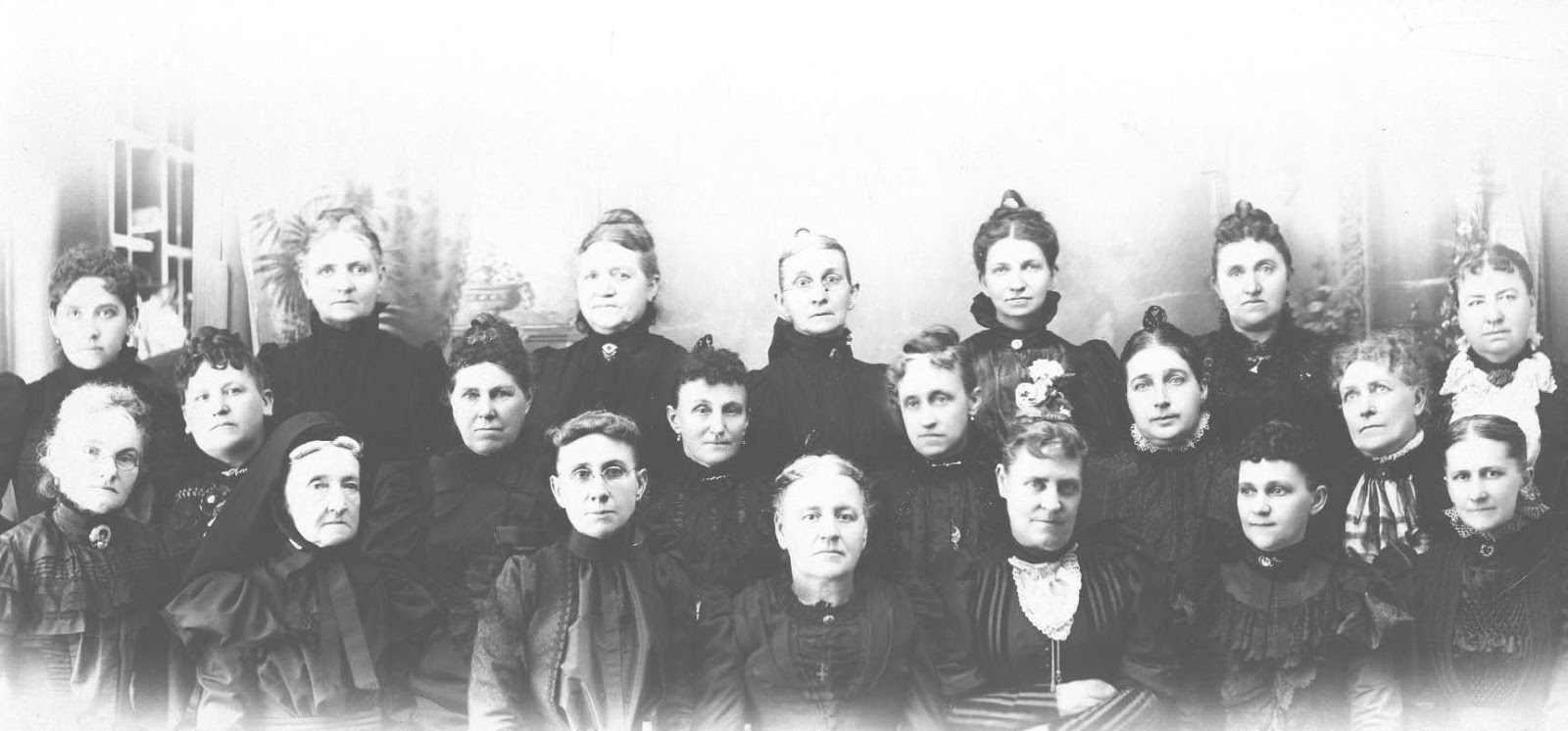
The Columbian Club was formed in Waterloo to represent Monroe County in the 1893 Columbian Exposition. The exposition was held in Chicago from May 1, 1893 through October 30, 1893 to commemorate the 400th anniversary of Christopher Columbus's arrival in the New World in 1492. It covered more than 600 acres and featured approximately 200 buildings (many were temporary), canals, and lagoons.


According to an article from the Metro-East Journal from October 31, 1968 the group "decided on a work of art with an agricultural motif as a device to symbolize the county, in which agriculture was - as it still is - the predominant occupation. From materials gathered by the members of the Sisters of St. Joseph created a design of a crescent and star, with a sunflower center, composed of grains, seeds and grasses, all grown in Monroe County. It was an elaborate piece of work. Doves and swallows fashioned of melon seeds, a millet seed grasshopper perching on a stalk of timothy, flowers made of grains, and wax fruits surrounded the centerpiece. On the crescent the words "Monroe County" were spelled out in gilded wheat. The device was mounted against a background of velvet in a five-foot-long glass case."

The group continued to meet monthly; their purpose was to help charitable causes. One was furnishing Thanksgiving Dinner for the County Alms House. The members prepared the food and delivered it via horse and buggy. Later the food was sent to the Alms House and the custodian's wife prepared the meal. The boy scouts and the Tuberculosis Association also benefited from the contributions of the Columbian Club.


The charter members pictured above included many of our ancestors.

Front Row (left to right):
Mrs. James Sennott (Mary Ann Newsham Starkey Sennott)
Mrs. William DeMint (Caroline Durfee DeMint)
Mrs. William Erd
Mrs. Marie Hoener
Mrs. George Ziebold (Wilhelmina Hoffmeister Ziebold)
Mrs. Joseph W. Rickert (Wilhelmina Ziebold Rickert)
Miss Owen (not shown)
Middle Row:
Mrs. Livingston
Mrs. Bode
Mrs. Sam DeMint
Mrs. Thomas Payne
Mrs. Fike (Cora Alice Starkey Fike)
Mrs. Frank Durfee
Miss Elizabeth Rainey
Back Row:
Mrs. Louis Adelsberger
Mrs. Matthew Crowe
Mrs. Alphonse Wetmore
Mrs Paul Brey (Sophia Durfee Brey)
Mrs. Hugh Murphy
Mrs. Fred Jobusch
Mrs. William R. Morrison

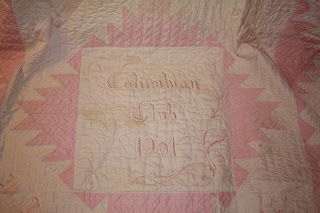
I am lucky to have a quilt made by the group in 1901 that was given to me by a descendant of Mrs. George Ziebold.


The quilt is pink and white and the square in the center says Columbian Club 1901. All around the quilt the names of the members are stitched into the quilt. They include Mrs. P.C. Brey (pictured above) Mrs. M.A. Sennott, Mrs. G.W. Ziebold, Mrs. S.C. DeMint, Mrs. F. Jobusch, Mrs. M.T. Crowe, Mrs. M. Talbot, Mrs. H. Murphy, Mrs. L. Adelsburger, Mrs. M. Bode, Mrs. L. Voris, Mrs. M. Payne, Mrs. C. Wetmore, E.A. Rainey, Mrs. Wm. Winkelmann, Mrs. J.M. Drury, Mrs. W.T. DeMint, Mrs. J.W. Rickert, Mrs. Frank Durfee, Mrs. Bainum, and Mrs. G.P. Livingstone.

One thing that stood out when I first got the quilt was the fact that except for Elizabeth Rainey who wasn't married and Mary Ann Sennott, who had been widowed for almost 40 years all of the women sewed their husbands initials into the quilt instead of their own.

The group celebrated their 50th anniversary in 1943, the only charter member that was still living was Minnie Ziebold (Mrs G. W. Ziebold). The club disbanded eight years later in 1951.

Sources
1. Article clipped from the Metro-East Journal. The date Oct. 31, '68 was written on it by Mina Sennott.
2. Picture of the Columbian Club given to the author by Mina Sennott, grandaughter of Mrs. George Ziebold and great-grandaughter of Mrs. Mary Ann Sennott.
3. Quilt made by the Columbian Club in 1901 given to the author by Jane Sennott Coakley, grandaughter of Mrs. George Ziebold and great-grandaughter of Mrs. Mary Ann Sennott.
4. The Newberry Digital Collections for the Classroom - 1893: Chicago and the World's Columbian Exposition website http://dcc.newberry.org/collections/chicago-and-the-worlds-columbian-exposition
5. The World's Columbian Exposition: Idea, Experience, Aftermath website http://xroads.virginia.edu/~ma96/WCE/title.html