Showing posts with label Sennott Family. Show all posts

Sunday, September 16, 2018

Harry B Sennott's First Automobile

1916 Ford Runabout

"In the spring of 1916 I had $500 saved up and bought a 1916 new Ford Roadster for $398.00. It took a crank to start them at night you opened the headlights and touched a match to the carbide gas to form the lights. At first, water was added to carbide - crystals, to generate gas. Later on gas was available in a tank fastened to the running board. There were no dimmers. If you had a flat, you jacked up the car and had to patch the tire from scratch. Some cars had a spare tire. The windshield wiper operated by hand. When it rained, curtains stored under the back seat were put on the sides." 

Harry wrote this in the autobiography he wrote in the Spring of 1968.

In 1916 Ford produced four models - a Coupe, Touring Car, Sedan, Town Car, and Runabout. There were 98,633 Runabouts produced and they sold for $390.00 according to the American Automobiles website. "They had 100 inch wheelbase and a 56 inch tread with 30 inch wheels and tires."  

The 1916 Ford was featured in a Westinghouse ad that can be found on Amazon.com. 


Sources

1. American Automobiles Website http://www.american-automobiles.com/Ford/1916-Ford.html
2. Amazon.com Ad https://smile.amazon.com/Ford-Roadster-Driver-Westinghouse-Electric/dp/B00QPSRCGG/ref=smi_www_rco2_go_smi_g1405964225?_encoding=UTF8&%2AVersion%2A=1&%2Aentries%2A=0&ie=UTF8
3. Picture of 1916 Ford Runabout https://commons.wikimedia.org/wiki/File:1916_Ford_T_Runabout_pic2.JPG
4. The Autobiography of Harry B Sennott manuscript in the collection of the author. 

Saturday, February 17, 2018

Academy of the Visitation Graduation 1909


Graduation Invitation - 1909
Visitation Academy, St. Louis, Missouri

Visitation Academy was founded in 1833 in Kaskaskia, Illinois by the Order of the Visitation of Holy Mary. The school moved to St. Louis in 1844. In 1909 it was located at Cabanne and Belt Avenues and there were 183 students enrolled.   

The Class of 1909
Top Row: Marion Bishop, Fort Sheridan, Ill.; Marie Sullivan, Geraldine Collum, Maizie Whyte, Georgia Sullivan of St. Louis. 
Second Row: Clara Ziebold, WAterloo, Ill.; Josephine Dickson, St. Louis; Gail Maguire, St. Louis; Susie Cabanne Goode, Honolulu; Maryzita Cahill, Kansas City.
Bottom Row: Norma Weis, St. Louis; Katherine Degnan, Wilburton, Ok.

Articles from the beginning of the school year refer to thirteen students. Celeste Withers is not listed as a graduate in the articles about the commencement exercises.  

Among the graduates in 1909 was Clara Ziebold, class valedictorian. Clara's scrapbook of her final year at Viz is in the collection of Rick Sennott and provided much of the material for this article. 

Clara Ziebold, 1909

The school year ran from September 8, 1908 to June 11, 1909. Class colors were lavender and white and the class flower was Lavender Sweet Peas. The Class yell was "Lavender and White, Lavender and White Class '09 Out of Sight". The class motto was "Amor Vincit Omnia" which means Love Conquers Everything.

Classes attended by the Seniors included French, Philosophy, Latin, Mathematics, Composition and Music, all taught by the sisters. Occasional musicals, recitals, and dances offered a break from daily studies for the young ladies.

Social events memorialized in Clara's scrapbook include dances for Veil Prophet, Halloween, Valentine's Day, an ice cream social, a St. Louis University football game, flower show, concerts and recitals. The girls were inducted into the Alumnae Association of Visitation Academy in April, 1909 at the Annual Re-union.

Botany Class

At the Church 

 The Story Was Rather Sad

The Tennis Fields

A private Graduation ceremony was held on Friday, June 11, 1909, only parents, teachers, students and the graduates were present. "Miss Georgia Sullivan read the class essay. Miss Marian Bishop, who won the certificate in music, played a piano solo, and a very enjoyable musical program was given by the students." Archbishop Glennon made an address and presented the diplomas and medals.

The text of Clara's valedictorian address was preserved in her on hand in the scrapbook:

Dear Sisters and Companions,

The coveted and earned distinction to speak for my class has been bestowed upon me.
In a certain sense I am proud of it, it is sweet. But I feel the throne pierce through the gathered flower. My words must say farewell, must tell the ending of the beautiful period in which our budding lives have been under a training hand.

In the retreat blind of dangers, weak little girls we have grown in the sunshine of culture, we have tried our minds at modest sciences, Have had imparted to them the dogmas of the highest  that of religious have been taught to see and love in every beauty and event something divine have been urged to duty by sweetest advice and soothing consolation and led from sorrow by the hand of love.

Looking back upon it we catch glimpses of blue skies, sunshiny ripples, green hedged fields, pleasant smiles we hear girls laughter and the sisters words of sweet correction

We must leave it! How blessings brighten as they take their flight. But is our happiness doomed to fade in the sphere of womanhood? Are not the influences of the world all our friends? There are dangers in society we are told beware Into this great unknown may that his open before no we must go alone. With what wisdom shall we choose and with what success shall we engage in the activities that there invite our trial? With what strength  shall we resist the fancies that may steer us into unsafe whirlpools of pleasure? We are encouraged; we are warned by loving words and inspired by fondest hearts. They say "let not your will like faulty air ships be whirled astray, but let it keep firm in the God -given course so love that others grief may be your own. Let adversity work in you its glories. Let you sorrows be wreathed with virtues. Character thus trained will mold others and be perfected according to the words given by your alma mater

Failure will be our own achievement. We will try to held this lesson and by being her true daughters praise our Alma Mater. 

Most beloved and revered teachers, gratitude for the sacred treasures you have given us we express for each in the lines of the poet

Though time her bloom is steeling theres still beyond his act the wild flower wreath of feeling the sun beam of the heart

Let us our dear companions, friends remain and you dear sisters, mothers be to us who bid you all a sad, a sad farewell.

After the ceremonies, Mr and Mrs. J. F. Sullivan, parents of Georgia Sullivan, entertained the class at a dance held at the Normandy Club. 

Sources
1. The Girl Graduate, Her Own Book, scrapbook of Clara Ziebold's senior year at Visitation Academy in St Louis, Missouri. Original in collection of Richard Sennott. 
2. "School Days at Visitation Academy", unidentified newspaper clipping from scrapbook of Clara Ziebold.
3. "Notes from Visitation Acadmey, Cabanne", unidentified newspaper clipping from scrapbook of Clara Ziebold.
4. Unidentified newspaper clipping in scrapbook of Clara Ziebold described the commencement exercises. 


Sunday, February 4, 2018

Waterloo High School Class of 1906

Graduating Class of 1906
Standing: Carlisle Morrison, Alfred Hess, Harry Sennott
Seated: Hulda Jobusch, Julia Crocker


The commencement exercises were held in the Memorial Opera House in Waterloo, Monroe County, Illinois on Wednesday evening, May 30th, 1906. "The stage had been tastefully decorated with pottages and ferns, and the hall was cozy and cheering." The program included an oration by each of the five graduates. 


The ceremonies opened with musical selections by the Orpheus Orchestra followed by the salutatory by Miss Julia Crocker titled "Public School Education." "Her delivery was splendid, clear and distinct, and her topic showed much care and skill in its preparation. Her reasons for a good education were along sound lines and showed a splendid mastery of her subject."

Miss Emma Quernheim played a musical selection before the next speech, "Kind of Patriotism Necessary Today" by Alfred Hess. "His subject proved a splendid one and was replete with references to many acts in the past events of our country's history. His work showed careful study and proficiency of detail which all admired."

William Bode, Alois Koenigsmark, Herman Oldendorph, and Louis Bode, the Mason Quartette, provided the next musical selection. Carlisle Morrison presented, "The Boss of the Animal Kingdom."  "The beginning of the subject was treated in a scientific manner with enough humor to make a radical departure from the usual commencement exercise, which made a decided hit with the audience. The delivery was splendid throughout."

"The Elements of Success" by Harry Sennott, "was another splendid oration, combining eloquence with deep study and careful preparation. The thread of the discourse was followed closely and in a logical manner which was greatly admired by the audience."

The Orpheus Orchestra returned to the stage and played selections from "The Mikado".

The final speech by the graduates of the day was by the Valedictorian, Hulda Jobusch. "In her topic Memories she paid a touching tribute to Memorial services, and to the many pleasing episodes of the class days, reminiscences of class mates and teachers."

Reverend J.B. House addressed the gathering on "the general subject of education". "The diplomas were then awarded after which the graduates were remembered by many admiring friends, receiving flowers and tokens in profuse abundance."

Diploma of Harry B Sennott

 The commencement exercises were supposed to be followed by the school picnic the next day, however, it was delayed until Friday by heavy rain. The students from all grades from the public school, the Catholic school and the Evangelical school gathered at 9:00 am Friday morning along with their families and friends. They "formed a line of 600, making a beautiful parade, the girls all with parasols and the boys with canes, and all with flags."

The procession marched through the streets to the park where the picnic took place. There was "a generous supply of lemonade" and "various games were indulged in during the day in which the little folks took great delight."  Business was suspended for the day at the request of the Mayor.


Sources
1. "Commencement Exercises", The Waterloo Republican, Wednesday, June 6, 1906, page 1 column 3.
2. "School Close", The Waterloo Republican, Wednesday, May 30, 1906, page 1 column 3.
3. Graduation Program, Waterloo High School, 1906 in the collection of the author. 
4. Picture of Graduating Class 1906 in the collection of the author.
5. "School Picnic", The Waterloo Republican, Wednesday, June 6, 1906, page 1 column 3.
6. Diploma of Harry B Sennott in the collection of the author. 


Sunday, January 8, 2017

Harry Sennott Marries Clara Ziebold


Society Belle Announces Engagement 

The headline in the Waterloo Times announced the engagement of Miss Clara Ziebold to Mr. Harry Brey Sennott. On Saturday, January 1, 1916, a party was held at the Ziebold house in honor of guests, Miss Marguerite Hubbell of Elgin, IL, Miss Marie Loper of Chicago, and Miss Geraldine Collum of St. Louis. The house was decorated with pink carnations, azaleas and ferns. After an evening of playing 500, luncheon followed. "With the service of the first course guests discovered  little cupids bearing the announcement of the engagement of Miss Clara Ziebold second daughter of Mr. and Mrs. George Ziebold to Harry B. Sennott only son of Dr. and Mrs. J. S. Sennott of this city."


Clara was active in a number of groups in Waterloo - the sewing club, the Domestic Science Club, the 500 Club to name a few. Members of the sewing club meetings provided the opportunity for Clara's friends to shower her with gifts.

On Thursday afternoon, March 16, Clara's sister in law, Mrs George C. Ziebold hosted the Sewing Club at her home - Whistlecote Farm. "The afternoon was most pleasantly spent at needle work. The guests also enjoyed a number of vocal selections by Mrs. Carlton Ball and Mrs. N Nasseem. At six o'clock delicious luncheon was served by the hostess. The dining room was artistically decorated in honor of St. Patrick Shamrocks, pretty gilt harps, green and white carnations and other emblems of the day were used effectively in ornamenting the luncheon table. The center piece consisted of a large green harp surrounded by carnations. Before leaving the table Miss Clara Ziebold was given a cord and asked to draw it toward her and as she did so the strings of the harp were rent asunder and thru the sides of the harp appeared many beautiful pieces of linen which were showered upon Miss Ziebold, whose marriage to Mr. H. B. Sennott will take place shortly after Easter. The shower arrangement was indeed clever and quite as much of a surprise to the other guests as it was to Miss Clara."

The festivities continued at the home of Mrs. Wallace Mitchell on Saturday, April 8th. The Sewing Club met in honor of Clara.  The guests sewed tea towels for the bride. "A dainty luncheon was served at five o'clock. The decorations were carried out in yellow. Jonquils were used for the centerpiece and the favors and place cards were Easter novelties. At the close of the luncheon an Easter basket of beautiful handkerchiefs was quite cleverly showered upon Miss Ziebold."

The final shower for Clara was a surprise kitchen shower held at the home of Mrs. Roy Gauen who entertained the Sewing Club at her home on the afternoon and evening of Thursday, April 13th.  "The dining room with its table beautifully decorated with pink sweet peas and dainty pink favors made a charming picture. In the center of the table, with a mass of sweet peas grouped around her, was found a miniature bride. Before her, leading from the center of the table, an array of fourteen dainty doll bridesmaids dressed in pink, made their way to Miss Ziebold's place at the head of the table. Covers were laid for fourteen. The hostess served an elegant six-course dinner, which in itself, showed an unusual amount of skill and proficiency in its preparation. Upon leaving the table the bride-to-be was surprised with a large basket containing many useful aluminum gifts."

The Wedding Ceremony


On the evening of Tuesday, April 25, 1916 at 5:00 pm Harry B Sennott married Clara M Ziebold in the parsonage of SS. Peter and Paul catholic church. Harry wasn't catholic so they couldn't marry in the church. The couple, their parents, and the attendants - Miss Evelyn Ziebold and Dr. I.A. Leunig arrived at the residence where they were married.


The bride "was tastefully gowned in an exquisite creation of white tulle hanging from the shoulders. The bridal veil was held in place by a wreath of orange blossoms and she carried a beautiful shower bouquet of brides roses and valley lilies."


Clara's sister Evelyn was her bridesmaid. "She wore white taffeta and silk lace and carried yellow roses."

A wedding feast and reception were held at the Ziebold residence on Moore Street immediately after the ceremony. "The party entered the home to the ever appropriate melody of Lohengrin, played by Miss Pearl Pinkel congratulations were showered upon the happy pair. The Easter colors of yellow and white were the basis of the decorations that adorned the home throughout and festoons of  smilax, Easter Lillies and jonquils made a very beautiful effect. Huge sprays and bouquets of sweet flowers, artistically placed, lent a charming fragrance that mingled with the happy atmosphere. A buffet lunch was served in the dining room; the bride cut the cake over which was suspended a bower of bridal tulle and smilax. The refreshments harmonized in color with the decorations. The entertainment consisted of pretty vocal selections by Mrs. Nazmy Naseem of New York and Mrs. Carlton Ball of St. Louis and numerous instrumental renditions."

The guests included many members of the couple's families - members of the Rickert, Hoffmeister, Pinkel, Brey, Cramer, Voris, Parker, Nasseem, Durfee, Fike, Ziebold and Sennott families all signed the guest book.

The couple traveled to St. Louis and later took the train to Chicago. They were supposed to spent their honeymoon at the Hotel Brevoort; however, they were called home early. Clara's brother George and his wife lost their daughter, Rose Marie.


The couple made their home in Danville, Illinois where Harry was working for the Illinois Department of Transportation.

Sources
1. Waterloo Republican, microfilm of newspapers from 2015-2016.
2. Waterloo Times clippings from the scrapbook of Clara Ziebold Sennott.
3. Autobiography of Harry Brey Sennott.


Sunday, January 1, 2017

Waterloo's Columbian Club

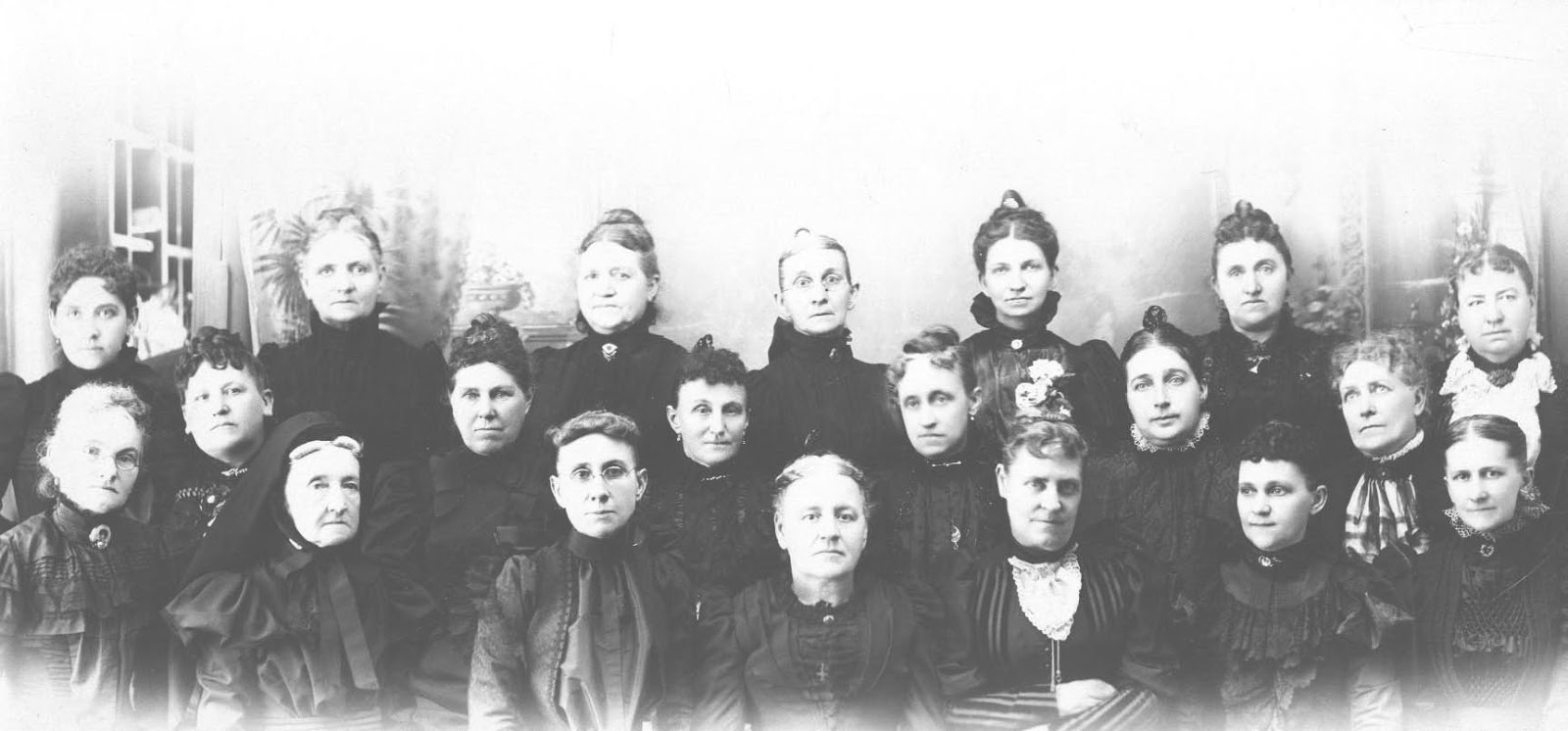
The Columbian Club was formed in Waterloo to represent Monroe County in the 1893 Columbian Exposition. The exposition was held in Chicago from May 1, 1893 through October 30, 1893 to commemorate the 400th anniversary of Christopher Columbus's arrival in the New World in 1492. It covered more than 600 acres and featured approximately 200 buildings (many were temporary), canals, and lagoons.


According to an article from the Metro-East Journal from October 31, 1968 the group "decided on a work of art with an agricultural motif as a device to symbolize the county, in which agriculture was - as it still is - the predominant occupation. From materials gathered by the members of the Sisters of St. Joseph created a design of a crescent and star, with a sunflower center, composed of grains, seeds and grasses, all grown in Monroe County. It was an elaborate piece of work. Doves and swallows fashioned of melon seeds, a millet seed grasshopper perching on a stalk of timothy, flowers made of grains, and wax fruits surrounded the centerpiece. On the crescent the words "Monroe County" were spelled out in gilded wheat. The device was mounted against a background of velvet in a five-foot-long glass case."

The group continued to meet monthly; their purpose was to help charitable causes. One was furnishing Thanksgiving Dinner for the County Alms House. The members prepared the food and delivered it via horse and buggy. Later the food was sent to the Alms House and the custodian's wife prepared the meal. The boy scouts and the Tuberculosis Association also benefited from the contributions of the Columbian Club.


The charter members pictured above included many of our ancestors.

Front Row (left to right):
Mrs. James Sennott (Mary Ann Newsham Starkey Sennott)
Mrs. William DeMint (Caroline Durfee DeMint)
Mrs. William Erd
Mrs. Marie Hoener
Mrs. George Ziebold (Wilhelmina Hoffmeister Ziebold)
Mrs. Joseph W. Rickert (Wilhelmina Ziebold Rickert)
Miss Owen (not shown)
Middle Row:
Mrs. Livingston
Mrs. Bode
Mrs. Sam DeMint
Mrs. Thomas Payne
Mrs. Fike (Cora Alice Starkey Fike)
Mrs. Frank Durfee
Miss Elizabeth Rainey
Back Row:
Mrs. Louis Adelsberger
Mrs. Matthew Crowe
Mrs. Alphonse Wetmore
Mrs Paul Brey (Sophia Durfee Brey)
Mrs. Hugh Murphy
Mrs. Fred Jobusch
Mrs. William R. Morrison

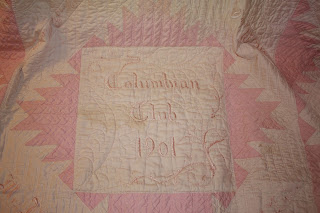
I am lucky to have a quilt made by the group in 1901 that was given to me by a descendant of Mrs. George Ziebold.


The quilt is pink and white and the square in the center says Columbian Club 1901. All around the quilt the names of the members are stitched into the quilt. They include Mrs. P.C. Brey (pictured above) Mrs. M.A. Sennott, Mrs. G.W. Ziebold, Mrs. S.C. DeMint, Mrs. F. Jobusch, Mrs. M.T. Crowe, Mrs. M. Talbot, Mrs. H. Murphy, Mrs. L. Adelsburger, Mrs. M. Bode, Mrs. L. Voris, Mrs. M. Payne, Mrs. C. Wetmore, E.A. Rainey, Mrs. Wm. Winkelmann, Mrs. J.M. Drury, Mrs. W.T. DeMint, Mrs. J.W. Rickert, Mrs. Frank Durfee, Mrs. Bainum, and Mrs. G.P. Livingstone.

One thing that stood out when I first got the quilt was the fact that except for Elizabeth Rainey who wasn't married and Mary Ann Sennott, who had been widowed for almost 40 years all of the women sewed their husbands initials into the quilt instead of their own.

The group celebrated their 50th anniversary in 1943, the only charter member that was still living was Minnie Ziebold (Mrs G. W. Ziebold). The club disbanded eight years later in 1951.

Sources
1. Article clipped from the Metro-East Journal. The date Oct. 31, '68 was written on it by Mina Sennott.
2. Picture of the Columbian Club given to the author by Mina Sennott, grandaughter of Mrs. George Ziebold and great-grandaughter of Mrs. Mary Ann Sennott.
3. Quilt made by the Columbian Club in 1901 given to the author by Jane Sennott Coakley, grandaughter of Mrs. George Ziebold and great-grandaughter of Mrs. Mary Ann Sennott.
4. The Newberry Digital Collections for the Classroom - 1893: Chicago and the World's Columbian Exposition website http://dcc.newberry.org/collections/chicago-and-the-worlds-columbian-exposition
5. The World's Columbian Exposition: Idea, Experience, Aftermath website http://xroads.virginia.edu/~ma96/WCE/title.html

Saturday, December 31, 2016

Harry B Sennott Attended the University of Missouri


Harry Brey Sennott

After graduating from Waterloo High School on May 30, 1906, Harry prepared to attend the University of Missouri at Columbia where he studied Civil Engineering. In September Harry and his cousin Dwight Parker, who also attend Mizzou, traveled to Jefferson City on the Missouri Pacific Railroad. From there they took the Missouri-Kansas-Texas railroad to Columbia. 

When Harry got there he found out that since he only had three years of High School he didn't have enough credits to enroll. He had to make up credits by attending the University High School for a year. He was allowed to enter the University conditionally at the end of the first semester.

Harry enrolled in the military school so he could join the band as a trombone player.  The Morrill Act of 1862 created institutions that cooperated in the National Defense program, by obligating all male students to take a basic course in military tactics. MU was one of the first universities to participate, they created the Missouri Military School in 1870. According to Harry, there were at least 300 students enrolled in the military school while he was there. The first university band was formed in 1885. This organization was the predecessor of the Reserve Officer's Training Program (ROTC). This explains the military connection that Harry included on his WWI Draft Registration card where he wrote that he spent two years in the Missouri National Guard. The state agency had no record of his service when I inquired after I found the draft registration card.

In 1907 the military and band represented Missouri at the celebration of the 300th anniversary of the founding of Jamestown at Sewall's Point, Virginia. The group traveled by train to the exposition and after spending a week at the exposition they took a side trip to Washington, D.C., Norfolk, Richmond and Williamsburg.

The Jamestown Exposition was held from April 26 to December 1, 1907. The exposition was a private enterprise that ended up loosing money.

Share of Preferred Stock of the Jamestown Exposition Company Preferred Stock

There were thirty-eight buildings planned on the 340 acre site but only fourteen were completed when the exhibition opened. All but two buildings were completed before the exposition closed. The exhibits included a model of the Panama Canal, a wild animal show, a wild west show, a recreation of the San Francisco earthquake and a recreation of the Civil War battle between the USS Monitor and the CSS Virginia, two ironclad warships. The cutting edge technology that was on display included automobiles, autoboats, and electric and steam engines. 

Birds Eye View of the 1907 Jamestown Exposition

The average attendance was 13,000 visitors per day which was below the expectations of the organizers. There were many famous visitors to the exposition including President Theodore Roosevelt who opened the exposition.

Harry was active while he attended the University. He pledged the Pi Kappa Alpha fraternity and served as the treasurer of the Engineering Society in 1910. He was a charter member of the Illini club which was formed in 1908 to "promote the interests of the University of Missouri in Illinois, and to promote the social relations of the members who are already here."

Harry was elected head yell leader in 1910. The Mizzou Tigers played the Kansas University Jayhawks in Kansas City on Thanksgiving Day. Harry and his fellow rooters painted 80 megaphones black in preparation for the game. The rest of the megaphones were painted yellow. The black ones were used to from a black "M" on a the yellow background. The game was a tie: MU 5, KU 5. The Thanksgiving Day football game took place every year between 1893 and 1910 in Kansas City, between KU and Mizzou. KU was the victor for all but 4 of the annual games. Beginning in 1911 the games were played at the two universities.

Harry attended the University through 1910. He learned that Dr. John Sennott, his father, was having financial difficulties so he went to work instead of returning to school in 1911 with the intention of finishing later, but he never did. 

Sources
1. Sewells Point and the 1907 Jamestown Exposition website http://www.virginiaplaces.org/parktour/jamestownexposition.html
2. "The Life of Harry Brey Sennott" a memoir written by Harry Brey Sennott in the Spring of 1968. The original is in the collection of family documents of the author.
3. University Missourian, newspaper digitized on the Library of Congress Chronicling America website. 

Thursday, December 15, 2016

Ellen Sennott McLaughlin - Did She Live to Be 101?


Ellen Sennott McLaughlin, photo from unidentified newspaper clipping

When Ellen Sennott McLaughlin died on Wednesday, 28 April 1909 the St. Louis newspapers carried stories about her being 101 years old. Her birth date according to the papers was April 11 1808. However, the catholic church baptism record for Ellen from St. Aidan's in Enniscorthy, Wexford, Ireland shows that she was baptized 30 April 1814.


There is a possibility that Ellen was not baptized as a baby, she might have been older but I don't think that is the case. There is a pattern in the family of inaccurate birth dates. Ellen's younger brother James's birth date is recorded on records in the U.S. as 15 May 1817, his baptism record is dated 1 May 1817 in the church records. Mary, the other surviving sibling, was baptized 22 Jun 1808 according to the church records and her birth date is recorded on her burial record at St. Patrick's Catholic Church in Tipton, Monroe County, Illinois as 21 June 1809.

I tried to find Ellen's death record but it isn't included in the Death Record index for St. Louis.

The census records show inconsistent ages for Ellen. Since we don't know who provided the information for the census records we don't know how reliable the ages are:


  • 1840 Census - Age 20-29
  • 1850 Census - 30 years, birth around 1820
  • 1860 Census - 45 years, birth around 1815
  • 1870 Census - 45 years, birth around 1825
  • 1880 Census - 60 years, birth around 1820
  • 1900 Census - 77 years old, year of birth is 1823


Since it isn't possible for two of the children of John Sennott and Mary Davis to have been born two months apart, and both of her surviving siblings' birth dates were recorded in error, it is more likely that Ellen was born in April of 1814. If this is true she would have been 95 when she died, not 101.

Sources

1. St. Aidan's Catholic Church Records, Ferns Diocese, Enniscorthy Baptism Register digitized on National Library of Ireland website. Microfilm 04249 - 02 page 79
 http://registers.nli.ie/pages/vtls000634056_079
2. Town books for Boston, Massachusetts. Massachusetts, Town and Vital Records, 1620-1988 database on Ancestry.com p 137
3. St Louis Post-Dispatch, Thursday 29 April 1909 page 22, found on Newspapers.com
4. Unidentified newspaper clipping titled "Dies at Age of 101 Mrs. Ellen McLaughlin"
5. 1840 US Federal Census, Monroe County, Illinois roll 66 page 346 Image 1201, Ancestry.com.
6. 1850 US Federal Census, Monroe County, Illinois, roll 121 page 73, Ancestry.com.
7. 1860 US Federal Census, Monroe County, Illinois, roll 212 page 149, Ancestry.com.
8. 1870 US Federal Census, Monroe County, Illinois, roll 261 page 470, Ancestry.com.
9. 1880 US Federal Census, St. Louis, Missouri, roll 733 page 4 ED 320, Ancestry.com.
10. 1900 US Federal Census, St. Louis, Missouri, roll 899 ED 439 sheet 14b, Ancestry.com.


Sunday, November 20, 2016

The Sennott House - 4th and Library Sts, Waterloo, Illinois

Three generations of Sennott's lived in the big white house on the corner of Fourth and Library in Waterloo, Illinois. The house sits on what were lots 8, 9, and 10 in Block 25 of Martin's Addition to the Town of Waterloo.


The East half of the lots belonged to William C Starkey, the first husband of Mary Ann Newsham Starkey Sennott. His estate sold the lots to William R. Morrison on October 27. 1860.

William R. Morrison sold the lots to James Sennott on September 21, 1861. When James died the lots passed to Mary Ann, his widow for the term of her life and then to their son, John. Mary Ann later purchased the West part of the lots on October 25, 1866 from William and Rosanna Sprigg. There is another deed for the West part of the same lots dated April 25, 1902 where the west end of the three lots having a frontage of 43 feet and 4 inches on Fourth Street passed from Gerhardt Voetman to John S. Sennott.

The deeds don't mention the house on the lots. Sanborn Fire Insurance maps show structures on lots in Waterloo. The two earliest maps from 1888 and 1894 don't include the area of town where the lots were. The 1899 map shows a structure but the lot is only partially shown on the copy on the St. Louis County Library website.  Here is the lot from the 1906 map.
The street address changed over the years, it started as 838 Fourth Street, by 1928 the address is listed as 302 W Fourth Street and later it became 408 W Fourth Street. Library was known earlier as First West. 

A memoir written by John S. Sennott to his son Harry in 1926 says that the family lived in Waterloo but doesn't say if it was this house. John was born January 23, 1861 and his father, James, died December 6, 1862. 

This is a picture of Mary Ann Newsham Starkey Sennott sitting on the porch of the house. There is no date on the picture. She died July 24, 1907. 


Harry wrote the story of his life in 1968. He says that his family moved into this house after Mary Ann died in 1907. Harry's two sisters, Ethel and Adele lived in the house until they moved into the Monroe County Nursing Home in 1975. I remember visiting them in the house when I was a little girl. 

Sources
Monroe County Deeds copied from visits to the Courthouse in Waterloo, Illinois
Deed Book 2 Page 141, Deed Book 2 Page 575, Deed Book 8 Page 597, Deed Book 35 page 103, Deed 99989 Record 117

Probate Files copied from visits to the Courthouse in Waterloo, Illinois
James Sennott probate file
Mary A Sennott probate file
John S. Sennott probate file

Death Certificates/Registers from Monroe County Courthouse in Waterloo, Illinois
James Sennott
Mary A Sennott
John S Sennott

Sanborn Fire Insurance Maps of Monroe County downloaded during visit to St. Louis County Library, 1888, 1894, 1899, 1906, 1913, 1928 

The Life of Harry Brey Sennott -- His Ancestors, His Children and Grandchildren" prepared in the Spring of 1968. Original in possession of the author.  


Sunday, October 2, 2016

James Sennott's Mexican War Service

James Sennott

Mary Ann Newsham Sennott filed for a widow's pension on 26 December 1889 which was approved 14 March 1890 and she began receiving $8 per month. She was allowed this pension because James served in the army during the Mexican War.

His service was included in the History of Randolph, Monroe, and Perry Counties, Illinois. It was also chronicled in his Compiled Service Record at the National Archives. James enlisted for twelve months in Miller's Company 2nd Illinois Foot Soldiers as a private. The unit was organized at Waterloo in May, 1846 and was mustered in at Alton, Illinois on 24 June 1846.


They served one year and were mustered out 18 June, 1847 at Carmargo, Mexico.


The Mexican War changed both the United States and Mexico. The U.S. gained a million square miles of territory by the signing of the treaty in 1848 at the end of the war. In 1845 Texas was disputed territory. The U.S. offered statehood, the residents voted to accept, and Texas became a state by December 1845. Mexico did not accept the annexation. The border of Texas was in question, the area between the Nueces and Rio Grande Rivers was disputed. U.S. troops that had been stationed in Texas moved to the Rio Grande River and arrived on the north bank on March 28, 1846. Mexico viewed this as an invasion and attached the Americans at Fort Texas which had been constructed on the bank of the Rio Grande River. Mexico officially declared war on July 1, 1846.

Company I was led Captain Madison Miller was part of the Second Illinois Regiment under the command of Colonel William H. Bissell who later became the eleventh Governor of Illinois . James was one of 55 privates in the company. The pay of a private was $15.50 per month.

The regiment was transported down the Mississippi River and across the Gulf of Mexico arriving at Camp Erwin near Victoria, Texas. From there they marched to San Antonio, Texas. Leaving there on 26 September 1846 they arrived in Santa Rosa on 24 October where they met no opposition. They marched on to Monclova and then on to Parras. Their original mission to capture Chihuahua was abandoned at this point. They remained in Chihuahua for twelve days. Having learned about Santa Anna's attack on Monterey, they continued marching and on 21 December they occupied Agua Nueva. They had marched for approximately one thousand miles.


In January, 1847 the regiment was part of a group that joined Major General Zachory Taylor and on 22 and 23 of February they took part in the battle of Buena Vista which was a victory for the American troops despite the fact that they were severely out numbered by Santa Anna's troops.  The battle was fought in a narrow mountain pass. The 2nd Illinois and two other units barricaded the road. They stood firm and conducted a slow, fighting retreat when units around them were collapsing.

Map of the Battle of Buena Vista


Print depicting the battle on the morning of Feb 23, 1847


Here is a quote from a report on the Battle of Buena Vista by  General Taylor dated 6 March 1847:

"The First and Second Illinois and the Second Kentucky Regiments served immediately under my eye, and I bear a willing testimony to their excellent conduct throughout the day... while the list of casualties will show how much these three regiments suffered in sustaining the heavy charge of the enemy in the afternoon...Colonel Bissell, the only surviving Colonel of these regiments, merits notice for his coolness and bravery on this occasion."

In 1847, Congress passed a law to award bounty land for service in the Mexican War. James received a warrant for 160 acres of land anywhere in the United States. James sold his warrant to Edward Mehan 18 February 1850 who redeemed the warrant for land in Monroe County.


James returned to Monroe County after the war. He and Amanda Miles were married 6 April 1848. The couple had three children who all died within a month of their birth. Amanda died 16 December 1854. Six years later he married Mary Ann Newsham Starkey, the widow of William Starkey. James and Mary Ann were married 10 February 1860.

James and Mary Ann had one son, John Stephen who was born 23 January 1861. James died 6 December 1862. Mary Ann was pregnant with their second child.  Mary Ellen was born 30 August 1863.

Mary Ann was left to raise two children from her first marriage and the two from her second marriage. This was not the last tragedy in her life, however. Mary Ellen died 11 October 1864 and her son William died 17 November 1864 at the age of 6. Between 1858 and 1864, Mary Ann lost two husbands and two children.


Mary Ann Newsham Starkey Sennott


In 1893, Mary Ann petitioned for an increase in her $8 per month pension. Her application says that she had been confined to her house for more than a year and is still unwell. She suffered a great deal and is not able to do manual labor. She is suffering from an inflammation of the kidney and bladder. Her income does not reach four hundred dollars a year. The increase was denied. She was still receiving $8 per month when she died 24 July 1907.

Sources
  • Taylor's official report of the Battle of Buena Vista -  http://www.dmwv.org/mexwar/documents/bvista.htm 
  • Bounty Land Warrants for Military Service 1775-1855, Department of Veterans Affairs, Record Group 15, National Archives, Washington, D.C.
  • Pension and Bounty Land Application Files Based on Service between 1812 and 1855. Department of Veterans Affairs, Record Group 15. National Archives, Washington, D.C.
  • Compiled Military Service Record, James Sennott, Pvt., 2nd Illinois Foot Vols, Mexican War, National Archives, Washington, D.C.
  • Mary Ann Sennott, widow's pension certificate no. 6876, Mexican War, National Archives, Washington, D.C.
  • Bauer, K. Jack, The Mexican War, 1846-1848, (Lincoln: University of Nebraska Press, 1974).
  • Combined History of Randolph, Monroe and Perry Counties, Illinois With Illustrations Descriptive of their Scenery and Biographical Sketches of some of their Prominent Men and Pioneers, (Philadelphia: J. L. McDonough & Co., 1883)


Sunday, September 25, 2016

Earliest Known Sennott Ancestor - John Sennott

On January 17, 1808 John Sennott married Mary Davis at St. Aidan's catholic church in Enniscorthy, Wexford, Ireland. The only other information on the marriage record is the witnesses, Judith Walsh and Philip Easten.


The records left behind by John and Mary are scarce. The church records at St. Aidan's begin in 1794 which is after John and Mary would have been baptized based on their ages in their burial records. If the burial records are correct, John would have been 35 when he married Mary who was 31 years old.

The couple had four children baptized at St. Aidan's.

  • Mary was baptized 22 June 1808, sponsors were Fredrick Kenny and Kitty Kenny
  • Ellen was baptized 30 April 1814, sponsors were Thomas Bryan and Nancy Murphy
  • James was baptized 1 May 1817, sponsors were Thomas Jones and Bridget Leary
  • Anna was baptized 3 April 1820, sponsors were Mick Brian and Margaret Keating
The couple were sponsors for the baptism of James Fitzgerald on 15 February 1821. This is the last record found for them in Ireland. 

Family lore says that the family emigrated to America through Canada, first to Boston and then on to Monroe County, Illinois. Very few records have survived of arrivals in Canada before 1865 and no records of the family arriving in the U.S. have been found. 

The family was in Boston by July of 1834 when Ellen married Patrick McLaughlin on July 30th. Two years later Mary married Phillip Byrns on  16 May 1836. There are no entries in the Boston City Directories during this time for the family.

The History of Randolph, Monroe and Perry Counties, Illinois written in 1883 says that a number of irish settlers arrived in New Design precinct of Monroe County shortly after 1835 and included the Sennott, Burns, and McLaughlin families. This would have been near Tipton where St. Patrick's Catholic Church was founded about 1850. Members of the Burns and McLaughlin families are buried in the churchyard at St. Patrick's. 

The first records of the family in Monroe County are in 1838. James purchased 80 acres of land in Section 33 Township 3 South Range 9 West on 25 August 1838. John purchased 40 acres adjacent to James's land on 27 August 1840 and Phillip Byrns purchased 80 acres in Section 34 on 10 October 1840.  All of these purchases were for public land from the State of Illinois for $1.25 per acre or $50 per 40 acre plot.


It is possible that the entire family moved west together or that James came first and then the rest of the family followed later. By 1 June 1840 the entire family had moved to Monroe county when they were listed on the 1840 Federal Census.  

John sold his 40 acres and James sold 40 acres to Martin Ryan for $250.00 on 7 February 1842. The deed is recorded in the Monroe County courthouse in Book F page 421-422. They made $150.00 profit on the land. 

Mary died at age 65 and her burial was recorded on 11 September 1842 at St. Augustine of Canterbury catholic church in Hecker, Illinois. John followed her two years later at the age of 71 and was buried on 1 September 1844. 


There are no tombstones remaining in the St. Augustine cemetery for John and Mary. 

Even though the records left by John and Mary are sparse, there is enough to outline their family and provide at least part of the migration path from Ireland to Monroe County, Illinois where their descendants lived for the next three generations. 


Saturday, September 24, 2016

The Education of Dr. John Stephen Sennott


Dr. John Stephen Sennott


At the age of 22, John graduated from St. Louis Medical College on Wednesday, 7 March 1883. The commencement took place at Mercantile Library Hall.  It was described in the St Louis Globe Democrat on Thursday, March 8th. "The stage was bordered with a rich collection of potted plants, which formed a dark background to the brilliant line of floral offerings, in tasteful and novel designs, that were presented to the graduates." The hall was "filled with the friends and relatives of the graduates, who testified their appreciation of the remarks of the different speakers by frequent applause." Mary Ann Newsham Sennott, John's mother, was probably among the family members attending. Professor J S B Alleyne, the Dean of the University, gave the main address, "on the importance of their duties in afterlife and foreshadowed the years of toil and care that awaited the members of the medical profession. He urged them to assiduous application and faithful attention to their patients, and after administering more equally sound advice, conferred the degree of M.D." on the 39 graduates included John. 

John's education began at the public schools in Waterloo, Monroe County, Illinois where he was born and grew up. On the first Monday in September, 1874 John started classes at St. Louis University in the four year Commercial Program. His classes that year included English grammar, US history, geography and elocution, practical and mental arithmetic, penmanship and catechism. John excelled at his studies and received special notice for distinguished diligence in his studies, the first premium for Christian Doctrine, a distinguished rating in English grammar, second premium in history and geography, and first premium in arithmetic. 

In his second year, John studied English grammar, epistolary composition, Bible history, geography and elocution, math, penmanship and catechism.  1875-76 was another good year for John he again distinguished himself at diligence and received a distinguished rating at arithmetic. He excelled a the semi-annual examinations for a second year in a row. 

1876-77 was John's third year at St. Louie U. He studied higher English composition and rhetoric, essays, debates, modern history and continued geography, book-keeping, arithmetic, algebra and Christian doctrine. John received a distinguished rating in book-keeping and excelled again at the semi-annual examination. 

1877-1878 should have been John's final year and he was listed in the records as a student from Illinois, but he did not graduate. The records don't indicate if he began the year and dropped out or never attended during that year. No other records have been found to shed any light on what happened.

We don't know why John dropped out of St. Louis University without graduating. The final disposition of his father's estate was dated June 30, 1877 so it might have been related. The executors of James's estate were Steven Miles and JW Drury. In a letter to his son, Harry, John talked about Stephen Miles. Stephen was the brother of Amanda Miles who was the first wife of James Sennott. John said that Mary Ann Sennott trusted Stephen after James's death. "He did not prove to be a friend and cost us a lot of money almost bankrupting Mother and me." There was a dispute over land left to James Sennott when Amanda died. The land was given to the couple by her father, Stephen W. Miles, Senior. According to John, they lost the land dispute. There is no mention of the dispute in the estate file.  By 1880, things must have changed since John continued his education. 

On Monday, September 27, 1880 regular lectures began at St. Louis Medical College and John was among the students. St Louis Medical College was located at the corner of Seventh and Clark. According to the Benard Becker Medical Library Archives at Washington University, St. Louis Medical College was chartered in 1841, it was part of St. Louis University. In 1849 the college moved to the building pictured above. In 1855 a separate charter was granted by the State of Missouri after pressure from the "Know Nothing" party, an extreme nativist movement demanded the medical school sever ties with the Roman Catholic university. In the 1870's the cirriculum was reformed and expanded and by 1880 all students were required to matriculate for three years before receiving a diploma. In 1891 the medical school became affiliated with Washington University as it's medical department. 

John attended St. Louis Medical College from 1880 through his graduation in 1883. The winter term each year began on the last Monday in September and continued through early March. The spring sessions began mid March and lasted for eleven weeks. The college catalogs provide detailed insight into the classes John completed. John was part of the first class who completed the new cirriculum. 

"Chemistry is taught in lectures (three a week) illustrated by experiments and specimens; the course embracing also selected chapters on physical science. A rich collection of chemicals and chemical and physical apparatus is at the disposal of the Professor of Chemistry." Chemistry labs were taught by the Demonstrator of Chemistry during the Winter session for Junior students and in the Spring session it was open to all students.

"Anatomy - Lectures (three a week) with practical demonstrations, and daily instruction in dissections. The anatomical rooms are under the superintendent and direction of the Professor of Anatomy...Surgical Anatomy is taught as a separate course of lectures, abundantly illustrated by dissections, (three a week) during part of the Winter session."

"Histology is taught by the Professor of Physiology in lectures, with the aid of magic lantern diagrams and photographs of microscopic preparations. Dr E Evers gives demonstraoins in Histology during the Spring session, three times a week."

"Physiology - The lectures (three a week) are illustrated by diagrams, chemical and physical experiments and vivisections."

"Therapeutics and Materia Medica - The lectures (three a week) are illustrated by a very extensive cabinet of materia mecida, with numerous plates, and a large collection of  of dried specimens of medicinal plants, and carefully selected samples of drugs, educating the senses to the physical properties of medicinal substances. During the Spring session, Dr. W E Fischel lectures on special Therapeutic Methods, twice a week."

"Principles and Practice of Medicine -  Didactic lectures four times a week." Medical clinics were held four times a week at City Hospital and St. Louis Sisters' Hospital. During the clinics there was instruction in ausculation, percussion, and physical diagnosis. Classes on Clinical Examination of the Urine were held during the Spring Session. 

"Pathological Anatomy is taught in connection with clinical medicine, the College possessing abundant resources for illustrating this branch in its extensive collection of pathological preparations and wax and plaster models."  Lectures were twice a week, "with microscopial demonstraions and the exhibition of recent specimens."
"Diseases of Children - didactic lectures once a week. Clinical lectures at the College Dispensary, twice a week."

"Surgery - Didactic lectures (three a week)." There were also clinics at St. Louis Hospital, City Hosptial, and the College Dispensary.

There were also weekly lectures or clinics on Diseases of the Genito-Urinary Organs, Ophthalmology, Gynecology, and Obstetrics. Here is what the students schedule included:


There were examinations for admission that John had to pass since he did not graduate from St. Louis University. They included English grammar, orthography and composition, mathematics and elementary physics. Since he did so well at St. Louis University, John should have passed with flying colors. After the middle term, students could take exams in Chemistry, Anatomy, Physiology, and Therapeutics and Materia Medica. If they didn't pass any of these they could retake them when they became candidates for graduation. 

The fees were $90 for the Winter term, $25 for the Spring session, and $10 for laboratory during the Spring session.  The students were required to purchase 12 textbooks listed in the catalog. There was also a Quiz Club that John might have joined. For $12.00 the students were presented "an opportunity for the free discussion of the important points of the subject matter of the lectures and thus enables him to express concisely his views, corrects erroneous conceptions, fixes the salient points in his memory, and prepares him not only for the Green Room, but also for the emergencies of practice."

In order to graduate, John had to meet four requirements:
  1. Be at least twenty-one years of age and of good moral character and been studying medicine for three years. 
  2. Attended the three terms listed above. The Spring sessions were optional.
  3. Notify the Dean of his intention to graduate in writing by the first of February.
  4. Pass examinations in Chemistry, Anatomy, Physiology, Materia Medica and Therapeutics, Principles and Practice of Medicine, Clinical Medicine, Surgery, and Obstetrics.
In addition, he could graduate "ad eundem" by "producing testimonials from physicians with respect to character and professional standing, entering the Senior Class for one term, and passing a satisfactory examination in all the above mentioned branches."
Dr. Wetmore, of Waterloo, was John's preceptor and the President of the Monroe County Medical Society. He would have been a mentor who provided instruction and oversight for John during and after he completed medical school. 

John practiced medicine in Waterloo until his death in 1933. 


Thursday, December 26, 2013

Sennott Family Christmas Memories


Harry and Clara Sennott and their family lived in the Ziebold family home at 306 South Moore Street in Waterloo, Illinois. Minnie Hoffmeister Ziebold lived with the family.


Clara knew her way around the kitchen and at Christmas she baked dozens and dozens of cookies. We all remember her sugar cookies, hershey kisses, angel whispers, hello dolly's, ranger cookies, chocolate chips, butterscotch treats and many more tempting delicacies.

Christmas traditions included dinner on Christmas Eve that included oyster stew and pickled herring. Since Honey's birthday was on December 25th, the family celebrated Christmas on Christmas Eve. There were often visiting students who went to medical school at St. Louis University with Jack or to University of Missouri where Honey studied Journalism.

After dinner and presents were exchanged, Clara's brothers, George and Max, and their families came to visit. The next morning began with mass at Sts. Peter and Paul Catholic Church for Clara and the children.
Clara's sisters Eveline and Loretta, and their families visited from St. Louis.

Clara made sure that Honey's birthday was special and didn't get lost in the Christmas celebration.

The afternoon held a visit to the Sennott family home at the corner of 4th and Library in Waterloo where Harry's mother, Elenora Brey Sennott, and his sisters, Ethel and Adele lived.

There was one very special Christmas Eve when Harry was in the service. Here is the story in Harry's own words:
Christmas 1943
      It’s 1943, Christmas Eve morning, and there’s GI Harry standing with arched thumb out on old Highway 66, a five-day pass in his pocket from Camp Crowder in Neosho, MO.
     An hour later a woman with a 10-year old son snoozing in the car stops, looks him over and asks where he’s headed. Hoping to get to St. Louis, he says, “and then another 25 miles down the Illinois side of the Mississippi to Waterloo.” She tells him to hop in, and as he does, she pulls a gun on him.
     Well, in truth, she merely shows him the revolver, but warns, “No funny business, soldier boy.” Harry smilingly informs her that he most positively plans to behave himself.
     Somewhere in the boondocks before reaching St. Louis they stop and she buys lunch for Harry. The woman then lets him out on the far west end of the city. After falling all over himself with thanks, he starts hiking to an old pal’s house.
     Christmas Eve is marching toward mid-afternoon by now. Although the old friend and his brother are off serving with the Seabees, their mother welcomes Harry, feeds him hot soup and lends him $5 so he can go downtown and buy a bus ticket home.
     Exhausted, he settles into a seat on the 5 pm to Waterloo. But as his eyes close, the man next to him shakes his arm, “Hey soldier, don’t you even remember what your brother looks like?”
     It’s Jack, who was in his internship at a hospital in St. Louis. Harry is speechless. Both are overjoyed, and they hatch plans to surprise the family, since no one knows Harry is coming.
     Home, they manage to slip in undetected. Jack hides Harry behind the big Christmas Tree in the living room.
     Harry is no longer exhausted, but the suspense is killing him. After greeting  Jack, the family moseys in,  Clara and Harry, Grandma Ziebold, Mina, Honey and Jane, who immediately begin searching for presents under the tree.
     Jack asks Clara, “Mama, what would you like most for Christmas?” “Oh, if only Harry could be here!” she answered.
     So he tells her to close her eyes till he counts to three, “One…two…three!” And out steps Harry from behind the most beautiful Christmas tree the family ever laid eyes on.
     Oh, the tears did flow that holy night.

Merry Christmas!