John Leonard Coakley was one of 4,700,000 men and women from the United Sates who served in uniform during World War One. He was also one of the 375,000 US casualties of the war. The injury he sustained would impact him for the rest of his life.
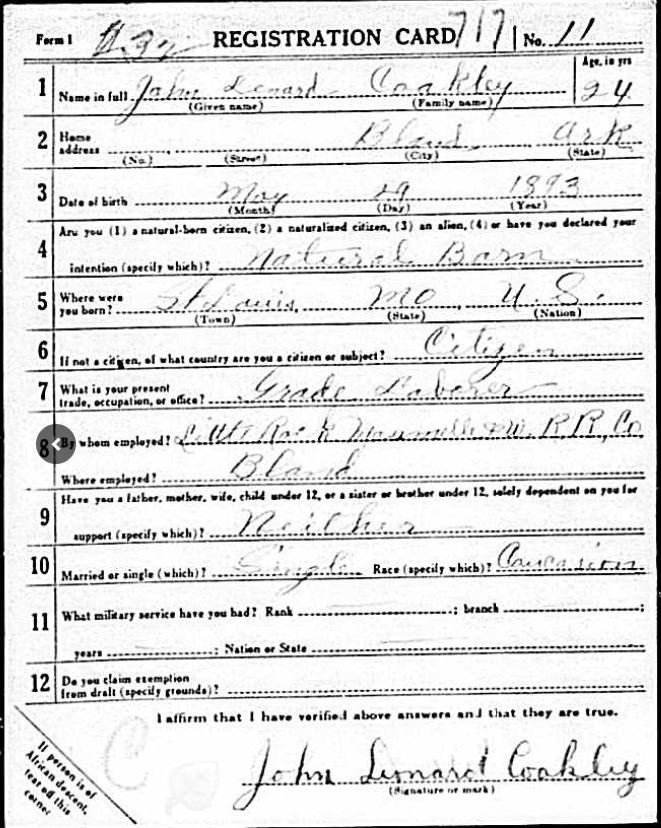
On May 19, 1917, the Selective Service Act was passed and President Woodrow Wilson was granted the authority to increase the size of the military temporarily. The first registration was on June 5, 1917; all men between the ages of 21 and 31 were required to register. John fell into this age group and completed his draft registration card in Benton, Saline County, Arkansas where he was working for Little Rock, Maumelle & Western Railroad as a grade laborer.


John enlisted as a Private in the Army at Little Rock, on August 20, 1917. He would serve in the 17th Field Artillery unit which was organized at Camp Robinson, Wisconsin in June 1917. Once they arrived at Camp Robinson, the men were organized into batteries. John was assigned to Battery B. Drills and instruction were the routine. On December 5, 1917 the unit received orders and they prepared to leave behind the cold Wisconsin weather. On Sunday, December 9 they set out for New Jersey. Arriving in Weehawken, New Jersey on December 12th where they were assigned to a transport ship. The unit boarded the U.S.S. Covington at the port in Hoboken, New Jersey and sailed for France on December 13, 1917 where they would join the Second Division.
Troop Transport List
U.S.S. Covington, Boston Navy Yard, October 4, 1917
The Covington was part of a fleet of eight ships accompanied by the battleship North Carolina. "The Covington was crowded. Every available inch of space was utilized. The bunks were arranged in tiers from floor to ceiling. Even the mess halls were sleeping apartments during the night. At night no light, not even a cigarette was allowed to betray the ships position to possible submarines. The few blue lights in the passage ways made a weird effect. Lifeboat drills occupied much of the time for the troops. On December 27, at 8:00 am the lighthouse off the coast of France was sighted." Eleven airplanes guided the ships into the harbor at Brest. The men remained on the ship until December 31st when they were moved to the railroad station. It was a cold, uncomfortable train trip across northern France toward the Swiss border. On January 2nd the men arrived at Valdahon. Sometime during the trip, John sent a postcard to Rose, his mother, telling her he had arrived safely in France.

Kansas City Times, January 9, 1918
Valdahon was setup as a fire school to introduce the Americans to French guns, shells and methods. French officers were assigned to each battery to assist in the instruction. The unit remained at Valdahon until March 8th when they were ordered to Rupt, on the line south of Verdun. By this time John had been promoted to Corporal. "The Regiment was the first artillery in the Division to throw shells over the line. The regiment familiarized itself in the different kinds of fire; such as -fire for destruction, harassing fire, counter-battery, counter-offensive and participation in coups de main. The French officers in charge commended the regiment upon its high grade of work."
John received a medal for his participation in the battle of Verdun
The Second Division was organized as an independent unit. On May 14, the regiment left on a three day march to Vannault les Dames. They continued to move to Revigny and then on to Chambors. After division maneuvers in the vicinity of Lattainville, they moved again, this time by train through Paris east toward Meaux. They detrained and marched 38 kilometers, "complicated by the presence of many civilian refugees and retreating French soldiers, the Regiment was halted at Cocherel. On June 4 the firing batteries were moved into position in the Chateau-Thierry sector." The successful action stopped the German drive toward Paris.
The Regiment was actively engaged in fighting for the next month. The Americans took the offensive and regained almost all the territory that had been lost in the Spring of 1918. The Regiment was relieved on July 7 and 8, moving back to northeast of La Ferte-Sous-Jouarre. The rest didn't last long, they moved to advanced positions on July 11 and 12. "The evening of Sunday, July 14, The Regiment received orders to march immediately to the wood near Betz. The march was begun a short time after midnight. There was no moon, but the sky was clear and the stars gave sufficient light for traveling. Our destination was reached about noon on the 15th." They continued to move to the line south of Soissons. "The spirit of the men was high during the march. Though they were compelled to spend two nights practically without sleep and though many of them were on foot during the entire march there was no complaining. All the men seemed eager to take part in what they felt was going to happen. During the brief stops men would doze for a few minutes at the side of the road and some would fall asleep in their saddles; but when it was time to move again the column went forth without delay."

American Gunners Sighting and Firing a Big Bun of the Howitzer Type and Destroying German Defenses in Preparation for an Advance by the Infantry
The battle began early in the morning of Thursday, July 18th. "It was a splendid day for the Allies. The Germans surrendered by the hundreds and the advance was hindered more by the difficulty of bringing up new troops, supplies and ammunition than by the opposition of the Germany Army. Very soon it as evident that the enemy had retreated so far that the 17th could not work effectively in its positions of the morning, so the pieces were ordered to advance." The Allies successfully attacked again on the morning of July 19th and moved forward again. The unit remained there through the 25th. The men were fatigued but continued to answer the call to fire while under continuous fire. They captured German ammunition and had a good time using it to fire on the Germans.
On the night of July 25th the French relieved the Batteries and the entire regiment slept at the Regimental Echelon and rested the next day. During the month of August, the Regiment moved a number of time, both marching and riding on trains, ending up near Mereville. Replacement troops arrived and officer changes were made.
September 3, 1918 the Regiment was ordered to move. "The wagons were packed late in the afternoon and after dark the front of the column moved out. An air raid over some nearby ammunition factories and aviation field added excitement to the departure." The Regiment was headed for St. Mihiel. At 1:00 am on September 12th the attach against the Germans started. "Since the Germans had concentrated a great deal of artillery in the St. Mihiel salient, it had been expected that there would be stiff resistance. But the Germans, having some idea of what was coming, had started to get most of their artillery back the night before. What was left was completely smothered. Many veterans pronounced this barrage the most complete that the war had produced."
Another march and train ride took the troops south of Somme-Py. The barrage started at 6:00 am on October 3rd. It was effective but the Germans held firm. The battalions underwent constant shelling and the fire from German machine gunners.
On October 6, 1918 German Chancellor Prince Maximillian send a note through the neutral Swiss government requesting that peace be restored through an immediate armistice with terms. President Wilson rejected the proposal. If there had been a different response to the request, John's life may have been very different.
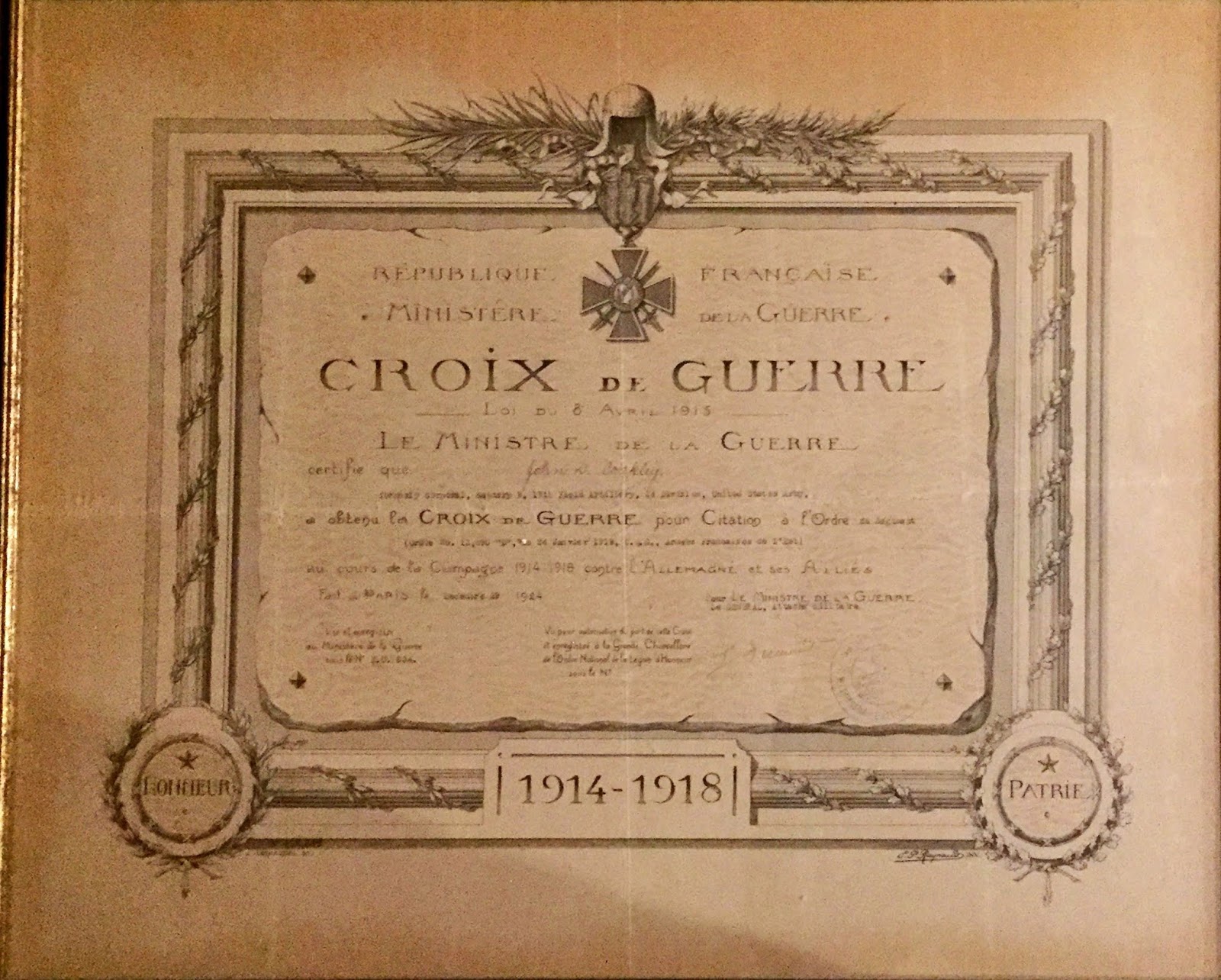
On the night of October 9, 2018 members of Battery B, including Corporal John Coakley were firing the Number 4 gun. The gun took a a direct hit and members of the gun crew were killed or wounded. John lost his left foot and his right thigh was badly torn. He made sure the other three injured men on his crew were attended to before he accepted help. A fellow soldier recalls John saying, "never mind me, Lieutenant, tend to the others first." For this he was awarded the Distinguished Service Cross and the French Croix de Guerre.
WWI Military Cablegrams - AEF and War Dept
After two fierce attacks the Germans were pushed back. "A great many horses were killed, but the loss in men was not as great as would be expected from the amount of shelling that the battalions underwent." On October 11th the Germans were making a general retreat. "So in the afternoon the guns, wagons, and caissons were hitched up and the pursuit began... Since the Germans were burning the villages that they left, the entire northern horizon was aglow."
The unit moved on to Meuse-Argonne. The Germans were defeated and they lost territory they had held through numerous previous battles. The Armistice was signed at 5:00 am Paris time on November 11, 1918 and went into effect at the 11th hour of the 11th day of the 11th month. The fighting continued right up until 11 pm.
The damage to John's left leg was extensive and part of his lower leg was amputated below the knee. After spending time in the hospital in France, John was sent to Brest where he boarded the U.S.S. Leviathan on February 3, 1919 with other wounded soldiers for the trip back to the US.
Troop Transport List
U.S.S. Leviathan
The Leviathan arrived in New York on February 11, 1919. John was sent to the army hospital at Fort Dodge, Des Moines, Iowa where he was fitted with a wooden leg. While he was in the hospital John was awarded his Distinguished Service Cross and Croix de Guerre medals. There was an awards ceremony on the Fourth of July at the Fort Dodge parade grounds.
The Distinguished Service Cross is the second highest US Army military award. It is given for extreme gallantry and risk of life in actual combat.
Distinguished Service Cross Certificate, John L Coakley
Distinguished Service Cross Awarded to John L Coakley
The Croix de Guerre was awarded by France for individuals who distinguish themselves by acts of heroism involving combat with enemy forces. John was recommended by the regiment level so his medal included a bronze star on the ribbon.
Award Certificate
John L Coakley's Croix du Guerre Medal
John was discharged on August 29, 1919 and returned to Kansas City, Kansas. He had surgery on the leg in the Spring of 1941 so he could have a new prosthesis fitted.
Discharge Papers of John L Coakley
There was a small hole in the calf of his wooden leg, he told his grandchildren that a yellow bird lived in there. We all believed Grandpa even though the bird was very shy and none of us ever actually saw it.
John's heart was damaged from the extensive blood loss from both the injuries to his left foot and right leg he sustained on October 9, 1918. He suffered a number of severe heart attacks through out his life. His lungs were also damaged, they were full of scar tissue from being gassed during the war so he coughed which aggravated his heart condition.
John didn't let the injuries he sustained while serving his country stop him from accomplishing his goals. He and his wife Helen homesteaded a ranch in California in 1929, they moved to Nevada in 1940 where they had a farm and raised chickens, and when they returned to Kansas he was a Professional Engineer and worked as a mechanical engineer. John loved his country. After the Japanese bombed Pearl Harbor, John tried to enlist as a Seabee but he was turned down because of his health issues.
Sources
Dudek, Debra M.
World War I Genealogy Research Guide Tracing American Military and Non-Combatant Ancestors, Electronic Edition Courtesy of The Doughboy Foundation and the US World War One Centennial Commission
"History of the Seventeenth Field Artillery, A.E.F. 1917-1918 Second Division" author not known. Original was in possession of Mrs. Helen Coakley. There is a letter attached dated May 12 1970 talking about a reunion from Don Kreger to James Sykes.
Order 13090 General Headquarters of the French Armies of the East, Personnel Bureau Decorations dated January 2, 1919.
Letters from John K Conant to John L Coakley dated April 2, 1942, June 25, 1966 and July 3, 1966.
WWI Draft Registration Cards, 1917-1918, Ancestry.com, stamped A3-1-45.
Texas Transportation Archive, "Tap Line Case" Summary of Little Rock, Maumelle & Western Railroad.
https://www.ttarchive.com/Library/Articles/Little-Rock-Maumelle-Western_ICC-Tap-Line.html
Honorable Discharge from The United States Army, John L Coakley, dated August 29, 1919.
Homestead File No 017373 US Land Office Sacramento, CA dated April 11, 1927 John L Coakley.
US Army Transport Service, Passenger Lists, 1910-1939. Ancestry.com Record Group 92, Roll 419.
Kansas City Times, "John Coakley "Over There", Wednesday, January 9, 1918 page 2 column 4, Newspaperarchives.com.
Kansas City Times, "Coris De Guerre Man's Fear," Friday, July 4, 1919 page 3, NewspaperArchives.com.
Topeka State Journal, "Casualties", Monday, December 23, 1918, p 11. NewspaperArchives.com
WWI Military Cablegrams - AEF and War Dept, National Archives, Publication Number M930, Record Group 120. Fold3.com
Des Moines Register, "Make Fourth Glorious at Fort - Three Yank Heroes to be Decorated; Fried Chicken "and Everything"", Friday, July 4, 1919. Newspapers.com
Framed certificates awarded to John L Coakley Distinguished Service Cross and Croix de Guerre in collection of the author.
The War of the Nation, Library of Congress Item 19013740 page 157. www.loc.gov
The American Army in the World War: A Divisional Record of the American Expeditionary Forces in Europe, 1921, Overseas Book Company, Manchester NH, p108, archive. org.
Selective Service Registration Cards, WWII: Fourth Registration, National Archives, Record Group 147, Serial Number U367. Fold3.com
Medals awarded to John L Coakley, in possession of his grandson.